
The 2,500-Year-Old Bong: Ancient Mourners in China Got High at Funerals
Burned residue in wooden braziers at a cemetery in western China is some of the oldest proof that people smoked cannabis to get high.
 Credit: Milenio [/caption]
The archaeologists who found this ancient smoking device call it, more scientifically, a "wooden brazier." In plain English, it's a big communal bong, used to heat the ceremonial hut during funerals. (A note for our more seasoned readers: yes, we know a bong is technically a water pipe, and there's no water involved here. We're using the word "bong" because it's the quickest, clearest way to say this thing was used to smoke cannabis.)
 Credit: Institute of Archaeology, China[/caption]
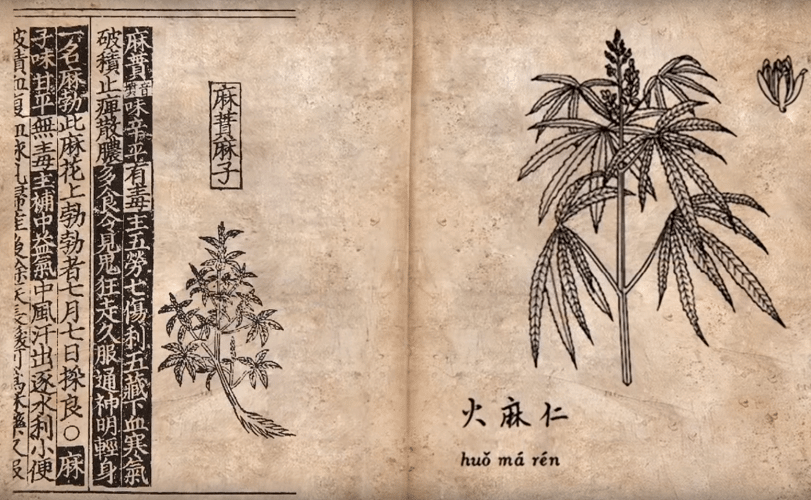
 Illustrations of cannabis in China 2,500 years ago[/caption]
Ten wooden braziers were found at the site, each with a deep, round hollow carved into the wood. The wooden bowls were lightly charred, and some of the stones inside held burned residue containing cannabinol (CBN).
The braziers were dug up from eight tombs at Jirzankal, an ancient cemetery dating to around 500 BC.
Tests turned up CBN in all of the burned residue, both inside the vessels and on some of the stones. CBN is what THC breaks down into as it oxidizes; in other words, it's what THC leaves behind after it burns and ages.
Illustrations of cannabis in China 2,500 years ago[/caption]
Ten wooden braziers were found at the site, each with a deep, round hollow carved into the wood. The wooden bowls were lightly charred, and some of the stones inside held burned residue containing cannabinol (CBN).
The braziers were dug up from eight tombs at Jirzankal, an ancient cemetery dating to around 500 BC.
Tests turned up CBN in all of the burned residue, both inside the vessels and on some of the stones. CBN is what THC breaks down into as it oxidizes; in other words, it's what THC leaves behind after it burns and ages.
 The find offers some of the first physical evidence backing up the famous claims of the ancient Greek historian Herodotus. In his classic The Histories, he described people of the Caspian steppe smoking cannabis during the first millennium BC.
 As Meng Ren and his co-authors point out in their paper, Herodotus described people sitting in a small tent while the plants burned in a vessel full of hot stones, and the Scythians used cannabis smoke as a cleansing ritual (something like a bath) after a burial. The smoking found in the Pamirs in this study, and in the Altai Mountains, clearly happened during the burial itself, though, so it may point to a different kind of ritual, maybe one meant to communicate with the divine or with the dead.
Or maybe they were just easing their grief and celebrating the life of the loved one they'd lost by tossing a little weed on the hot rocks.
As Meng Ren and his co-authors point out in their paper, Herodotus described people sitting in a small tent while the plants burned in a vessel full of hot stones, and the Scythians used cannabis smoke as a cleansing ritual (something like a bath) after a burial. The smoking found in the Pamirs in this study, and in the Altai Mountains, clearly happened during the burial itself, though, so it may point to a different kind of ritual, maybe one meant to communicate with the divine or with the dead.
Or maybe they were just easing their grief and celebrating the life of the loved one they'd lost by tossing a little weed on the hot rocks.

THE CLUB
Join the community
Growers with a name and a face, traceable batches, a real community. No smoke, no empty promises.
Join the clubKEEP READING
 NEWS
NEWSGrow Light Timers: What They Are and How to Set One for Your Grow
Digital, analog or mechanical: the cheap little gadget that keeps your light cycle dialed in while you sleep.
 NEWS
NEWSWhat Is Cannabis Cloning? Why Growers Do It and How It Works
From picking a mother plant to rooting the cut, here's why so many growers skip seeds altogether.